> For the complete documentation index, see [llms.txt](https://docs.scopescan.ai/llms.txt). Markdown versions of documentation pages are available by appending `.md` to page URLs; this page is available as [Markdown](https://docs.scopescan.ai/features/investigation-mode/address-clustering.md).
# Address Clustering
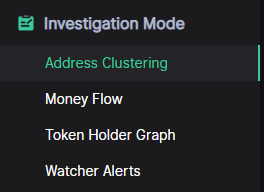
Find the **Address Clustering Tool** under **Investigation Mode** category
Enter an address in search bar and generate an address graph to visualize likely connected addresses. You can find likely connected addresses including Externally owned addresses(EOA), deployed contracts, exchanges, and more.
Click on any address node to see key information like ETH balance, total balance value, behavior tags, off-chain information and so on.
To see information about its cluster, click on the Cluster Detail.
You can drag any of the nodes to organize them based on personal preference. You can also expand and minimize nodes by **double-clicking** them.
You can also expand, minimize and hide nodes with the toolbar.
Click on the node you want to select and use any actions (1. Hide 2.Show Hide Nodes) on the bar. Click on refresh(3) to start over.
Put your mouse on the line between nodes, you will see the
* Reason why they are related with such a certainty **(Non-deposit address)**
* Transaction number, value and most transacted token **(Deposit Address)**